The World of Wend
The Turning
The world is called Wend, from an old word: turn. Most people believe that far beneath it, enormous beings push a stone and wooden wheel through the dark, and the seasons follow. No one has proof. Almost everyone has a reason to believe it anyway.
The Fraying
Above, Wend’s peoples waste their years arguing while the necessary work goes undone. Roads go unwatched. Graves stir. Wells answer with names instead of water. The old dark pushes back up. This is the Fraying.
Lundeberg Harbor
World-law is the bargain that keeps Lundeberg Harbor neutral: everyone obeys it because everyone needs the port, and everyone enforces it on Reaping Day. Enemies trade there, threaten each other carefully, and leave alive. It is also where the contracts are posted.
The Work
Someone has to go where the patrols stopped, put down what rose up, and come back paid. Adventurers are debtors, exiles, believers, and fools. The wheel turns. Someone has to bleed for it.
Peoples of Wend
Humans
The most varied people in the world, and perhaps the most insecure.
They raise kingdoms faster than Elves think possible and cut deals Dwarves call reckless. Where the old races lean on birthright, Humans lean on momentum, and momentum is cheaper to come by.
Their pact with the Orcs marks the new age. Alone they could not break Elven rule. With Orc strength beside them, they have started to believe they can.
What they claim: The gods watch from the stars, ready to smite anyone foolish enough to insult them, so Humans pray carefully and hunt for loopholes.
Elves
One people, split between cloudline towers and the dark beneath.
They built their cities high in the mountains and looked down with polished contempt. For generations the world mistook them for gods, which the Elves found understandable. Then came the Unmasking: worship ended, tribute stopped, and only the pride survived.
The houses that stayed above grew colder. The houses that went below remade themselves in the deep, chasing the strength and brilliance they believed the surface had failed to reach. They will not give outsiders a name for their city, only Home. Surface Elves call the cavern-born The Dim. The cavern-born call the surface-born The Proud. Neither word is praise.
What they claim: The gods once existed, saw how well the Elves were doing, and retired out of respect.
Dwarves
Gold, ale, and the size of one’s beard.
Gold proves you were bold enough to take the risk. Ale proves you lived long enough to enjoy it. A beard proves the world has not managed to kill you yet.
They chase treasure, but also a grudge: not since the Goblins and the Great Swindle will a Dwarf suffer being made a fool. One who dies rich, drunk, and surrounded by enemies is counted a success.
What they claim: A divine accountant of greed and gain, who judges any creature unwilling to improve its lot unworthy of the breath it wastes.
Halflings
An accident no one wanted to claim.
Born of Humans and Elves, and discarded by both as a disgusting mistake. So they left, built comfort into a culture, and made survival a craft.
Mistake their cheer for foolishness at your own cost. When the world still took the Elves for gods, a Halfling auditor recorded one of them dying at an Orc’s hand, in the public record, and filed the proof where anyone could read it. That single page ended an age. Then they went back to lunch.
What they claim: A god probably exists, but Halflings figure they are not clever enough to settle the matter, and would rather not ruin lunch trying.
Goblins
Hated by nearly everyone, including each other.
Small, fast, vicious, and clever in the meanest way going. A Goblin rarely wins a fair fight, which is why it almost never lets one start. Poisoned blades, faked surrenders, an exit already picked.
Its first loyalty is to itself. The second is to whatever keeps it breathing for the next five minutes. Coin counts as breathing.
What they claim: They loudly deny believing in anything at all, usually while stealing a religious object.
Orcs
Not the warlike people outsiders imagine.
For generations they lived as clans bound by law, ancestor rites, and a debt to the land. Then the Elves drove them from the old territories, and endurance alone does not save a people. The survivors marched to Human lands and struck the bargain that defines the age.
They do not fight for love of war. They fight because peace was taken from them, and because someone has to stand where the blade is falling.
What they claim: All gods wait in death, where every life is weighed and answered for. An Orc’s loyalty belongs first to the dead, and no living crown outweighs that.
Ogres
If you can carry it, it belongs to you.
Huge, misshapen, and frighteningly strong. Not evil by any philosophy, just hungry, confused, quick to anger, and nearly impossible to stop once they are moving.
To an Ogre, theft is not a crime but a test. If a thing was taken from you, perhaps you were not holding it tightly enough. It pays to point one at the enemy and keep your fingers crossed.
What they claim: The Capstan Colossi are the truest gods. Ogres settled the question after seeing a painted wall that seemed to explain it clearly enough.
Trolls
Every border is a scar.
They ruled the swamps until the Ogres claimed them, one muddy mile at a time. The ashlands they fled to nearly finished the job before reshaping them: hide hardened to cracked, cooling-lava stone, blood running hot.
The old swamp wisdom did not leave them. It curdled into suspicion. To Trolls, anyone entering their land uninvited has come to invade.
What they claim: All talk of gods is betrayal. In Ashroot Hold, speaking of divine protection is punishable by death, a sentence Trolls call practical, not religious.
Owlkin
Born from fear of the depths.
When the first humans gave themselves to the black water, the faithful who remained begged the Night Sky for eyes to pierce the dark and claws to seize what crawled out of it. Their bones ached. Feathers split the skin. They were not born. They were made.
Patient, precise, and unnervingly watchful, they sleep light, speak with care, and waste little motion. The hunt is never finished, because the dark keeps sending things back.
What they claim: The Night Sky, which answered their prayers for the strength to hunt. Their duty is to save what can still be saved, and to kill what crawls out of the dark when pity is no longer enough.
Inkborn
Once human. They answered the call from below.
They bound abyssal cephalopods to themselves for vision, long years, and the terrible comfort of being chosen by something that answers back. Luck bends strangely around them; travel with one and fate itself seems to squirm.
The change runs head-down and never stops. By the end, host and parasite are one being, claimed by the abyss for good. Until then, there is work the surface will pay well to have done.
What they claim: The depths. To the Inkborn, land is a wound, the black water is the only honest kingdom, and in time all life returns below.
Classes
Warrior
Warriors stand in the doorway when the thing arrives. Heavy steel, few questions, hard to move.
Rogue
Rogues treat rules as trouble for slower people. They work quiet, take what matters, and leave before anyone looks.
Cleric
Clerics make faith practical. They carry other people’s lives into the worst of it and mend what breaks.
Archer
Archers read the wind, the ground, and the enemy. Then they put a single shot exactly where it should be.
Occultist
Occultists open what should stay shut. They spend blood, death, and curses because power has a price.
Entertainer
Entertainers keep a doomed company steady. They make bad nights survivable and frightened allies harder to kill.
Subclasses
Berserker
Warrior + Warrior
A brutal fighter who feeds on the harm they cause. Berserkers hit one target hard and heal from the wound they open.
Brigand
Warrior + Rogue
Part warrior, part cutthroat. Brigands fight dirty, opening wounds that keep bleeding long after the strike has landed.
Paladin
Warrior + Cleric
A holy warrior who wards the whole company. While the ward holds, every blow the party takes mends part of itself.
Ranger
Warrior + Archer
A hunter who fights with poison. Rangers mark a target and let the venom stack with every arrow that follows.
Horseman
Warrior + Occultist
A reckless charger who pays for power in blood. Horsemen spend their own health to strike harder than their weapon should allow.
Gladiator
Warrior + Entertainer
An arena fighter who plays to the crowd. Gladiators single out one opponent and grind them down, hitting harder the longer the duel goes on.
Assassin
Rogue + Rogue
A killer built for the single perfect strike. Assassins gamble on high-variance attacks that either miss the mark or end the fight outright.
Zealot
Rogue + Cleric
A fanatic who fights and heals in the same motion. Every strike a Zealot lands mends the company standing behind them.
Poacher
Rogue + Archer
A predator who hunts what was meant to be off limits. Poachers cripple a target first, then punish the weakness and leave it open for allies.
Graverobber
Rogue + Occultist
A scavenger who profits from the dying. Graverobbers hit hardest against wounded foes and take back health with every kill.
Swashbuckler
Rogue + Entertainer
A quick-blade fighter who never stops moving. Swashbucklers pile on extra strikes and stay alive by being too fast to hit.
Bishop
Cleric + Cleric
A priest who spends themselves for the company. Bishops carry the party healing and will trade half their own life to arm everyone at once.
Sentinel
Cleric + Archer
A guardian who turns attacks back on the attacker. Sentinels ward the party so blows meant for allies come back at the enemy.
Exorcist
Cleric + Occultist
A cleric who learned the dark and uses it against itself. Exorcists drain the life out of an enemy and cleanse what it leaves behind.
Reveler
Cleric + Entertainer
A performer who keeps the company standing and swinging. Revelers heal the party and leave them hitting harder than before.
Marksman
Archer + Archer
A precision shooter who does not rely on luck. Marksmen deal steady, predictable damage while everyone else is at the mercy of the dice.
Soulshot
Archer + Occultist
A gunslinger who loads each shot with something darker than lead. Soulshots drain life and keep what they take.
Bard
Archer + Entertainer
A performer who bends the luck of the whole party. Bards deal little damage themselves but make everyone around them roll better.
Lich
Occultist + Occultist
A dark caster who treats their own life as fuel. Liches burn health for heavy dark damage and claw part of it back.
Bokor
Occultist + Entertainer
A charm-worker who marks a victim for the whole party. Everything strikes a hexed target harder, and the company hits harder while it holds.
Maestro
Entertainer + Entertainer
A conductor who moves the whole company. Maestros grant the party extra strikes so everyone acts more often than the enemy can answer.
History of Wend
The Rootbound and the Elsewise
The Age Before Counting
The Rootbound walked the forests and buried themselves when their time was done. The silent Elsewise rearranged stones, rivers, and bones for reasons no one could read, then simply stopped appearing. The things they left behind still surface.
The Age of Cloud Worship
Before the Fraying
From cities raised among the clouds, the Elves let the world mistake them for gods. Tribute became devotion, and devotion became habit. In time, many Elves came to believe it themselves.
The First Calls Below
Before the Fraying
When prayers to the sky went unanswered, some humans knelt at the black water instead, and something answered. The first Inkborn traded their faces for vision, long life, and the comfort of being chosen.
The First Molting
Before the Fraying
Terrified of the depths, the faithful begged the Night Sky for the strength to hunt what crawled out of the water. They woke with their bones aching and feathers splitting their skin. The first Owlkin were not born; they were transformed.
The Unmasking
Before the Fraying
A Halfling auditor documented an Elf dying at an Orc’s hand, in the public record, and the proof spread through every tavern and trade hall. Elves could die. Worship curdled into resentment overnight.
The Fall Beneath the Mountains
Before the Fraying
Stripped of their divinity, some Elves were driven deep into the caverns. The cavern-born reshaped themselves harsher and stranger, and named their hidden city only Home, because outsiders deserved no directions.
The Swamp Loss
Before the Fraying
The Ogres took the Troll swamps one muddy mile at a time. The Trolls fled into volcanic ashlands that nearly killed them, then hardened their hides into cracked, cooling lava and their wisdom into suspicion.
The Great Swindle
Before the Fraying
Dwarves and Goblins, once allies in greed, split over a betrayal neither side will explain the same way twice. The treasure vanished, the trust with it, and the hatred has never once cooled.
The Red March
Before the Fraying
Hunted from their lands by the Elves, the surviving Orc clans marched on Human territory, armed, starving, and carrying their dead. The Human king offered refuge for strength. The alliance that defines the age was struck.
The World-Law
The World-Law
No one could own Lundeberg Harbor without ruining it, so everyone agreed that no one would. Under world-law it became neutral ground for trade and treaty, paid for once a year, in full, on Reaping Day.
The Fraying
27 AF · The present
No dark lord. No prophecy. The world is simply coming apart faster than its squabbling peoples will mend it. Into the gaps go the adventurers, and this is where you sign on.
The Codex
The Wendwrights
Why the world turns
The world is named Wend, a word millions of years old and worn so smooth that almost no one still hears its meaning: to turn. The world keeps turning whether anyone wishes it to or not.
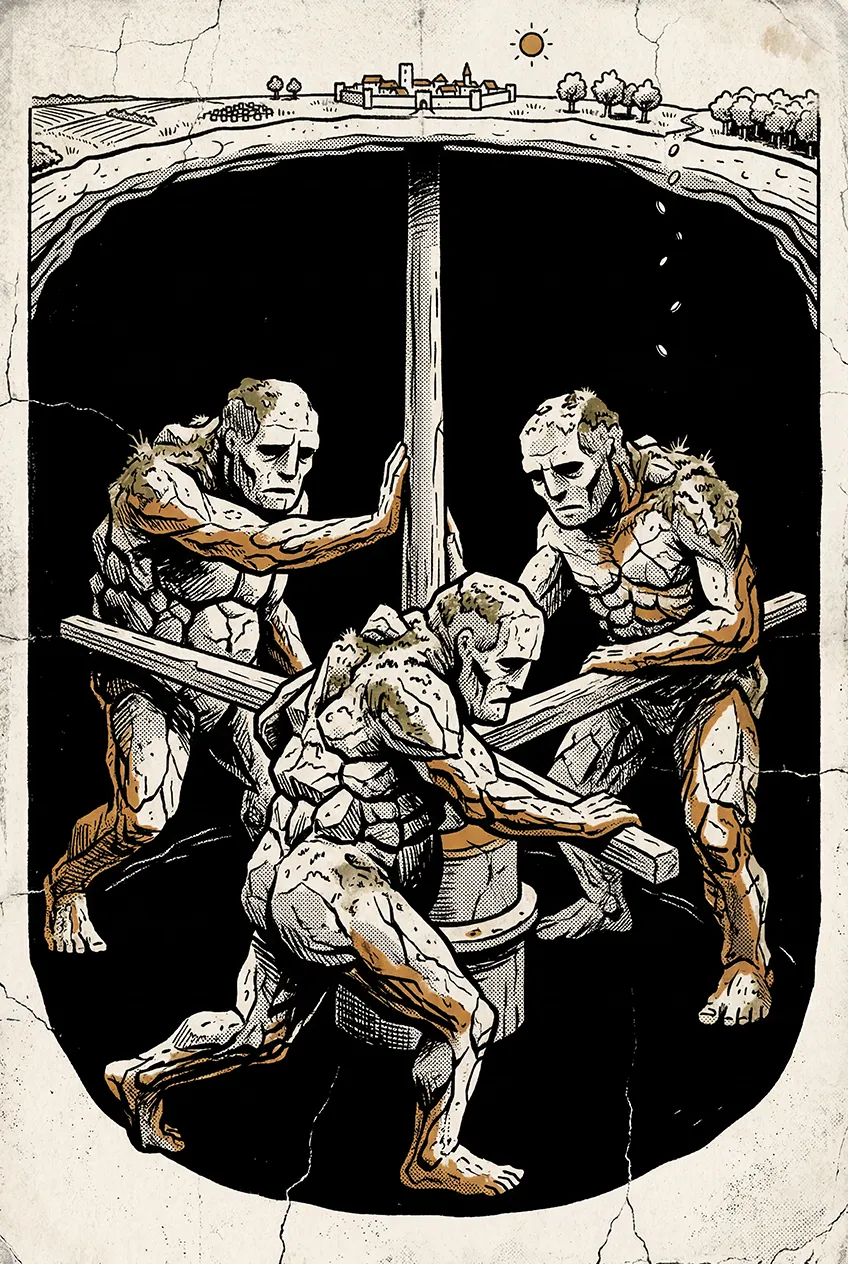
The common account holds that deep at the center of the world, enormous and ancient beings push a colossal stone capstan, and as the wheel comes around the seasons come with it. Spring follows winter because they have not yet stopped. These are the Wendwrights; the older texts prefer the grander name, the Capstan Colossi.
No one pictures them as kind, or clever, or aware of the surface at all. They are imagined as laborers rather than rulers: vast, tireless, indifferent things doing slow and brutal work that keeps everyone above them alive, without once looking up.
No one has ever seen one. The belief survives for the plainest reason there is. The seasons keep arriving, and something has to be bringing them.
The Underturners
Who mends the wheel
A thing that large cannot turn forever without wearing against itself. Stone splits. Beams catch. The world grinds in places no map will admit to. The beings said to mend those places are the Underturners; farmers call them the Belowhands, and Dwarves call them unlikely.
Lately people have begun to notice small wrongnesses. Spring comes damp and late. Winter ends, returns for three days, and leaves again without explanation. Migrating birds circle one hill until they drop from the sky. The clerks of Lundeberg Harbor file these under weather, infrastructure, or religious complaint, depending on which drawer still has room.
No one agrees what a failing capstan would look like, only that they would rather not learn. The grim consensus is that the world would not burn or shatter. It would simply stop, the seasons locking where they stood, half the world freezing and the other half cooking, with the seam between them the last border anyone ever argued over.
The clean version says the Underturners mend faithfully. The darker version says they are not servants but prisoners, fastened to the turning so the world above can keep surviving. The worst version says they stopped years ago, and the Fraying is only the surface beginning to notice.
The Elsewise
The age before counting
In the oldest age, the Elsewise moved through the world. They walked through streets, walls, people, and wars as though all of it were equally beneath remark. They shifted stones from one hill to another, stood in rivers for days, rearranged bones, and drew circles no one could read.
They never spoke, never traded, never once acknowledged that another living thing existed. Then one day, or one century, they stopped appearing. There was no battle, no grave, no farewell. People simply noticed, years on, that none had been seen in a long while.
Every theory about them has been argued and none has held. Some say they were early Underturners, correcting the weight of the world before the damage reached the wheel. Some say they were repairing it. Some say sabotaging it, slowly.
So the world has settled them the only way it can, by agreeing there is nothing to settle and that asking is poor manners and worse for sleep. Whatever they were rearranging, they may not have finished. Or they finished exactly enough.
The Black Water
The mirror below
Where there is black water, the heavens appear beneath it: open tide pools, sealed wells, flooded cellars that have never met a star. Not the weather overhead, but the deep Night Sky itself, calm and exact, as if the world were a thin floor laid between two identical darks.
So the Inkborn kneel and look down and call it listening to the depths. The Owlkin stand and look up and call it answering the Night Sky. No one has proven these are two different acts.
The voice the Inkborn hear from below and the power that remade the Owlkin from above share the same patience, the same appetite for what is human, the same habit of returning something older than what it took.
Some Owlkin orders have burned every record that mentions reflected stars. Some Inkborn keep the ashes in jars. Both call it reverence. On certain still nights a person can stand at the water and see two skies at once, and notice, to their lasting discomfort, that the stars do not match.
The Unmasking
The day certainty died
For an age the Elves let the world mistake them for gods. From cities raised among the clouds they accepted tribute, and tribute became devotion, and devotion became habit until many Elves believed it themselves. The other peoples knelt because no one had seen the alternative.
Then a Halfling auditor, of all things, documented an Elf dying at an Orc’s hand. In writing. The proof moved through every tavern and trade hall faster than any army could have, and it carried a single unbearable fact: Elves could die.
Worship curdled into resentment almost overnight. Stripped of their borrowed divinity, some Elves were driven beneath the mountains, where the cavern-born reshaped themselves harsher and stranger. The age of certainties was over, and most of those certainties turned out to have been lies, transformations, or both.
The Gods, Such As They Are
Ten peoples, ten certainties
Humans hold that the gods live in the stars, watching for any insult worth a smiting, which has made them careful with prayer and inventive with loopholes. Elves maintain the gods once existed, saw how well the Elves were doing, and retired out of respect.
Halflings allow that a god probably exists but would rather not ruin lunch settling it. Orcs believe all gods wait in death, where every life is weighed and answered for. Dwarves and Goblins share a divine accountant of greed and gain, though Goblins loudly deny believing anything, usually while pocketing a relic.
Ogres take the Capstan Colossi for the truest gods, chiefly because one of them once saw a painted wall that seemed to settle the matter. Owlkin answer the Night Sky. Inkborn answer the depths, which they do not call a god so much as the plain truth: that land is a wound, and in time all life returns below.
These were the old certainties. After the Unmasking, the wiser peoples keep their faith the way they keep a knife. Close, quiet, and never fully trusted.
World-Law & Lundeberg Harbor
The only safe city left
Lundeberg Harbor is the largest and oldest port on the western coast, and the last truly safe place in the world. Every people tried to hold it. This went poorly enough, often enough, that they all arrived at the same conclusion at once: if no one could own it without ruining it, then everyone would pretend no one owned it at all.
So came world-law, and the Harbor became neutral ground. Trade happens there. Treaties are signed there. Enemies sit across tables, insult each other with great care, and leave with the limbs they arrived with. Violence is forbidden, theft is forbidden, and the law survives not because anyone loves peace but because everyone loves what the Harbor makes possible.
Because the law belongs to everyone, so does its enforcement. The truce is the only thing every people agrees is worth keeping, which is precisely why breaking it is the one crime no one can buy their way out of.
Reaping Day
How the law is paid
The punishment, like the law, belongs to everyone. Once a year, every condemned lawbreaker is brought before the city on Reaping Day. One executioner from each people takes part, so that no single people can be blamed for the sentence, and none can claim clean hands.
The executions are public, ceremonial, and horrifyingly well attended. Merchants sell food along the route. Goblins come in disguise to see whether anyone they know drew an unlucky lot.
No one calls the day cruel. The Harbor’s word for it is necessary, and in a world with one safe city, necessary is a higher virtue than mercy.
Contracts, Death & Heirlooms
The work you are signing into
Adventurers are licensed through the Contract Halls of the Harbor. The license is not an honor. It is a signed acknowledgment that everyone understands the odds. Contracts are physical things, with seals, hazard classes, and clauses, and the Hall keeps a ledger of every party that signed and did not return.
Death is expected. It is not quite failure. The waiver names a beneficiary, the Registry settles the estate, and the contract, if unfinished, returns to the board at a revised rate. Grief here looks like paperwork, and the paperwork is sincere.
What matters is what gets left behind. A blade, a charm, a drinking horn, a suspiciously useful bone, handed from one doomed grip to the next. Each item’s docket lists its prior owners and how ownership ended. Some dockets run long. The Registry does not editorialize.
This is how the world survives now. Not by prophecy, not by chosen heroes, but by small companies of questionable people taking dangerous work, dying in memorable ways, and leaving just enough behind for the next to get a little farther.
Elsemarks
What the dead leave you
Every character you make will die. What survives is the mark they leave. Earn one of the world’s rare mythic effects and it is yours for good, carried into every life that follows: an Elsemark, left by one of your else-lives. A few of the thirty-six:
MarkSlotWhat it doesFugueWeaponA hit may cast one of your own abilities, free.EncoreWeaponCast an ability and it may fire a second time.Troll BloodBodyHeal a little at the end of every round.BacktalkShouldersWhen you are hit, strike back for half a swing.Double or NothingLegsEach hit may double its damage, or halve it.Last LaughBootsDodge an attack and your next hit is a crit.
Bind one to the heirloom your next character carries, and the run begins with a little more teeth than the last. They span the six gear slots in three tiers, and death never takes them back.
The Fraying
The present
No dark lord. No prophecy. The world is coming apart faster than its squabbling peoples will mend it, and the gaps are widening from the edges in. Roads scream. Wells answer. Things that should have stayed buried are testing the soil above them.
The Harbor keeps its truce and the board keeps its contracts, and into the gaps go the adventurers, because no one better is coming. It is the twenty-seventh year since the alliance that defines the age, and this is where you sign on.